Tuesday, May 08, 2007

Tear It Down or Renovate It: A Growing Dilemma For Home Buyers.

For quite some time I’ve been chanting that it’s time to let go --- let go of the notion that a 70-year-old house has enough charm and redeeming factors to be worth saving.

With energy concerns becoming more prevalent and the cost of utilities continuing to escalate, we need to change our thinking here on Martha’s Vineyard. Charm is a relative term and there is nothing charming or attractive about a tiny 70-year-old house with little to no insulation, cramped bedrooms, one bathroom with leaky plumbing and a tiny kitchen that is inadequate by today’s standards on a crumbling wet foundation.

Circa 1900 near Campground, Oak Bluffs


I’d even go so far as to say there is nothing charming or redeeming about some of the houses built during the last 20 to 40 years. We allowed some real junk to be constructed during the 1980’s real estate boom, and a lot of the circa 1970 construction is ugly and functionally obsolete. Aside from the emphasis today on energy conservation, modern high-technology in new homes is also important and advancing at a breathtakingly rapid pace. Today’s upscale consumers want that technology, but they don’t want the kinds of subdivisions typical of suburban America. They want the charm of the Martha’s Vineyard lifestyle because that is what attracts them. But they want that charm to include all the bells and whistles they are used to at home; they want the best of both worlds. The psychographic profile of people moving to the Vineyard is changing and that will make modern in-home high-technology even more important. No longer are we just a summer retreat or retirement community. People come here for a gentler way of life while simultaneously carrying on their off-Island careers.

It might very well cost you more to renovate an older house than to build a new home. So, what’s the answer? I think the eco-conscientious solution is to scrape them, raze them, bulldoze and remove them from the land and start over. Some people call this “Bash and Build”. It may sound shocking, but it’s been happening in other parts of the country for quite a while now. One off-Island builder who has worked on numerous teardown projects in recent years says, “In my opinion, it’s the hottest trend in real estate.” So how do you get this old house off of your nice lot? You can either have the structure demolished, lifted off the foundation and removed in one piece or deconstructed. The latter method which entails reclaiming lumber and reusable building materials will cost you more money and more time than just driving a bulldozer through the front door. Another option is to donate the old structure to affordable housing. It would then be lifted off the foundation and removed in one piece. This sounds like a good idea, but there is a backlog of inventory right now. Let your eco-conscience be your guide. You might also be eligible for a substantial tax deduction if you can donate the structure or the salvaged reusable materials.

Speaking of costs and savings --- it could cost anywhere from $20,000 and up to demolish and cart away the old structure. That cost doesn’t include the foundation, but the foundation material can also be recycled. When the site is clean, you can start from scratch building a new and possibly bigger dream home on that nice lot. In the end you may be paying more “all in” for the finished product, but you will be in a location you want, instead of next door to yourself in a new subdivision without the landscaping intrinsic to older quintessential communities like big trees (to provide screening and privacy). Remember, most of the best locations on this Island are already developed or in conservation. Another factor to consider is financing. If you’re not paying cash, the best solution is to acquire a two-phase loan for a project like this. The first part will be a construction loan which historically will be at a higher rate --- perhaps one-half to one point above prime. You will need a construction contract and approved plans in order to get the loan, but the plans don’t have to be set in cement --- no pun intended. The second part is for the conventional home mortgage. If you’re unable to get your ducks in a row for this type of financing you will end up paying closing costs twice.

We already have a number of cookie cutter subdivisions on the Island, but there are a number of mature small and medium size communities in great locations on the Island where the houses range in size and style unlike the uniformity of modern subdivisions. In off-Island communities it has always been understood one should never to have the biggest home in the neighborhood. But on Martha’s Vineyard that is not a concern. The teardown trend is starting to become more accepted, and inadequate and smaller houses are being replaced with more substantial houses. I am not talking about “McMansions”, nor am I a proponent of them. I believe smart buyers who have identified and moved into the older communities by replacing dilapidated homes with new homes will create an environment for more buyers to come in and build new homes. This will fuel a renaissance in these communities. The land on this Island is just too precious to pretend patch-and-paint houses contribute to the value of the land.

New architect design reproduction near Sunset Lake, Oak Bluffs
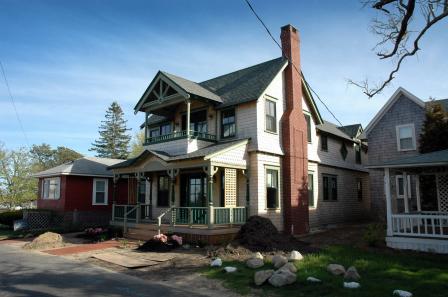


I do think it is critical for neighborhoods to be vigilant and take responsibility for their future well-being. It will be important for residents of these communities to establish home owner associations if they don’t already have them. They need to create covenants to ensure there are safeguards to prevent someone from coming into the community and building an enormous A-Frame glass tent or Quonset hut that doesn’t fit the general character of the neighborhood. Variety is a good thing because it gives character to the community and ensures more expensive homes will blend in visually and economically. This is all part of preserving the future value of your investment and the value of this magical Island we all love to live on.


Monday, April 23, 2007

All Real Estate Is Local, but that has not been the perception?

In David Lereah’s new book, “All Real Estate Is Local”, he references the investment mistakes his Grandpa made by listening to the national news instead of paying attention to ”local influences and activity” He goes on to say, “Whatever the national trends are with regard to real estate – whether they are booming or busting – what really matters is what the market conditions are in your region, town, or neighborhood.” David Lereah is Senior Vice President and Chief Economist of the National Association of Realtors® (NAR).

Starting in 2001 real estate speculation began picking up steam in certain areas of the country that were growing in popularity. These areas were primarily coastal cities on the east and west coast. It would be five years before this trend would run its course. Investors were quick to jump on board with the hope of making a quick buck -- and they did. Properties were selling before a shovel touched dirt or a hammer struck a nail. We saw this in the 80’s here on Martha’s Vineyard when the construction and housing market was out of control, but we learned from that bad experience and won’t let it happen again.

When the press started reporting the news that the Boom was over, they did so by painting a national picture of doom and gloom with a broad brush. We all listened to the reports. Prospective buyers relished the thought of getting a good deal, “a steal”, and regaining control of what had been a so-called seller’s market that had all but shut out everyone except the well-healed from the Vineyard real estate market. Sellers, on the other hand, started to panic but refused to give up their position. They fervently resisted lowering what, in most cases, were overly inflated prices based upon subjective personal opinions instead of factual market price analysis provided by seller agents.

We entered a buyer-seller standoff period where nothing was happening, except at the very top of the market. But even there activity slowed down and sales were few and far between. No one wants to overspend and appear foolish regardless of how much they are worth. The wave of panic continued to build while rolling from coast to coast, and everyone was talking about a “buyer’s market” whether the perception was true or not.

On the Vineyard, sellers continued throwing chum at the market week after week in the form of insignificant price reductions. So like any good bargain shopper, buyers continued to wait, wondering how low the market would go. Personally, from the beginning I saw this as an opportunity for a leveling of the market and never believed the negative hype as it pertained to Martha’s Vineyard. Water seeks its own level and it would just be a matter of time, I thought, before we reached that point.

All of a sudden, but not by surprise, there was a new specter looming on the horizon. Was the housing bubble about to burst? Buyers had been led to believe there was no end in sight for the hot market and prices would just continue climbing. They were drawn into a false sense of security and anticipation of assumed future gains. Greed and some very creative financing products also encouraged buyers to overextend themselves by committing to attractive short-term, low adjustable interest rate loans. This enabled them to get into the market with little or no money down. But in some areas of the country the market suddenly came to a halt and prices started to decline. Frantic buyers not wanting to lose money immediately started canceling new home sales contracts and in many cases forfeiting substantial deposits.

With prices now plummeting by double digit percentages in many popular cities, and adjustable mortgage rates going up as much as double at the first reset, many new home owners found it easier to simply walk away from their homes purchased with up to 100% financed loans they could no longer afford. This was the case in cities like Boston, Cape Cod, Phoenix, Las Vegas, Los Angeles and Ft. Lauderdale where there had been overly zealous growth, but it was not that way throughout the entire country.

On Martha’s Vineyard the rate of appreciation was above average but not even half of what it was in the 1980’s. There were only a handful of speculators here that might have been in jeopardy. The Vineyard has always been a pricey market and that is not by accident. People who “get the Vineyard” are passionate about wanting to live here and make emotional decisions; quite often paying a premium to be part of the unique Vineyard lifestyle.

It was not only the home buyer who was affected by the slowdown in the market. Existing home owners who were courted and vigorously encouraged to take equity out of their existing homes for that dream vacation to Hawaii or that slick new Escalade were finding themselves in an unexpected upside-down or negative amortization position. The news of a threatened foreclosure glut loomed heavily on the horizon --- but once again we should have remembered --- real estate is local.

When a homeowner cannot maintain their mortgage or sell their home to save themselves, the end result is usually foreclosure and over a million home owners in the US are facing that end today. The foreclosure process begins when a borrower is over 30 days late with a mortgage payment. The lender will usually send a letter of notice to the borrower along with notification to the state’s Land Court notifying them of an action to foreclose. This does not imply a fait accompli, as most borrowers are able to work out the loan with the lender before they lose their homes. With prices continuing to decline in some areas, options have become more limited. However, in Massachusetts, the number of foreclosures is not even close to what it was in 1992. Government leaders are now calling for state and federal assistance to subsidize aide to home owners threatened with foreclosure.

Although Martha’s Vineyard is a wonderful and very special place, like all good things, greed can play a major part in pushing the envelope. We experienced a period for many years where everyone thought they had the goose that laid the golden egg. Many properties came on the market for ridiculous prices, both at the very top and at the very bottom of the market. Still, we relied upon the market to have the last word, but the astounding reality was that there was always someone who would pay the price. Today this is changing to a great extent not only because of the perception of a more level playing field or buyer’s market, but also because buyers are choosing to have their own agency representation.

So where are we today? I believe we are at a tipping point in the Martha’s Vineyard real estate market, but it will not be without a little more pain. One of my pet peeves is there are too many substandard, poorly maintained buildings of no important historic significance for sale here that have outlived their economic and functional usefulness. There is an old real estate expression, “underneath it all is the land”, and in many cases that is where the value is --- not what sits on the land. I maintain that many of the 40, 50 and 70 year old structures should be removed and replaced with more attractive energy efficient “Green” construction. Sellers have to realize they can no longer expect to get $400,000 to $500,000 for a property with a dilapidated house or unheated shack, when the value of the land is almost half of that selling price. Buyers need to realize they are not going to be able to “steal” properties. They must have confidence that if they pay a fair price for a property, they will have a solid investment that will appreciate in time, but not overnight.

We have to come to the realization on Martha’s Vineyard that this is not a buyer’s market, but an opportunity for a balanced market. A market where properties are priced fairly and sellers have realistic expectations. However, the lower to middle-end of the market is distorted because we still have a number of sellers who are not realistic or serious about selling their properties; they’re just fishing. Their perception of what their property is worth, albeit uninformed or ill-advised, overrides the facts. There are three phrases I constantly hear that always make me smile: “The seller is motivated”; “The seller doesn’t have to sell”, and “The price is negotiable”. What the heck does all that mean? Does it mean the motivated seller will accept well below market value or the non-motivated seller is firm on the price or will only accept above market value? Does anyone in the market today assume that prices are not negotiable?

The pool of qualified pre-approved buyers at the lower end or entry level of the Martha’s Vineyard real estate market is drying up. Lenders are adopting much stricter guidelines for buyers with limited resources and marginal credit. If you were pre-approved for a loan last year you may not be eligible for that same amount today. A larger down payment may be required and you will most likely not get a loan approval without verifying your income. If you are contemplating a purchase this year, save yourself disappointment and wasted time for everyone by going to a lender and getting pre-approved for a mortgage. Believe me, you are better off knowing your pocketbook will match your expectations. Negotiations are difficult enough today and being pre-approved will strengthen your bargaining position.

I’m the owner of SplitRock Real Estate, an EXCLUSIVE BUYER AGENCY and to paraphrase a statement from a REALTOR® sponsored national ad campaign, real estate is my life. I know my business; I study it and I’m passionate about it. My perspective is unique because I view the market from the buyer’s vantage point, and my goal is always to arrive at a fair deal. I will do my best to protect my buyer clients and will look after their best interests. My task is to educate and counsel my buyer clients so they can make informed decisions they will be comfortable with. I encourage you to begin or continue your real estate education at www.SplitRockRE.com .

Wednesday, April 18, 2007

Martha’s Vineyard is Living On The Edge

Living on Martha’s Vineyard we are all used to the threat of seasonal hurricanes and a steady flow of Nor’easters during the year. We take them pretty much in stride assuming that the weather forecasters are just creating drama and nothing much will happen. The last real storm damage anyone remembers was during Hurricane Bob and the Halloween Nor’easter in 1991. Actually the Halloween storm did more damage to the beaches and dunes than Bob did.

Once again a Nor’easter has slowly crept across the middle of the country and up the eastern seaboard hovering over the Martha’s Vineyard shoreline for days. Although the body of the storm moved out into the Atlantic, the effects of the storm are still lingering with high winds, rough seas and unusually high tides continuing an assault on our beaches and dunes. The final report card for this storm is still being written but severe errosion has been observed along the northwest coast and the Lucy Vincent Beach area.

Here is one report on the damage sustained to one of the most fragile and beautiful areas we lovingly covet and try to protect, albeit this is also viewed as a positive phenomena.

(Click here to view >) Norton Point Beach breached; crashing seas open channel

Friday, March 30, 2007

Should Second-homes be subjected to a Lodging Tax?

On February 15th I commented on a proposed Lodging Tax that would affect second-home rentals on Martha's Vineyard and Cape Cod. People who depend upon the rental income of their second homes to partially offset their carrying costs, would have to pass along the tax to their tenants in order to make their numbers work. The rental rates on Martha's Vineyard are already high. We have to ask ourselves, at what point will vacationers start to look elsewhere for better values? For people dreaming of owning a home on Martha's Vineyard and relying upon rental income as part of the purchase equation this tax would deliver a real blow to the process. Here is an update on the debate taken from an editorial at CapeBusiness.net:

"Should second-home rentals be taxed? Some things to consider as the debate intensifies over whether to tax summer rentals:

"Yes, it would level the playing field. Latest numbers show a waning occupancy rate for hotels and motels in the summer, surely a result of competition from summer home rentals.

"But what happens if second-home owners dependent on that income find themselves faced with as much as a 9 percent tax increase? For them, it is seeing their property tax almost double. This on top of rising energy costs, insurance coverage increases and a harder time renting their homes due to an oversupply of rentals. At what point will second-home owners decide to put their home on the market because the economics don’t work – especially since they no longer can expect double-digit price appreciation?

"And if those houses go on the market, what impact will that have on all house prices, including those owned by primary-home owners?

"Will municipalities worried about waning occupancy taxes find that scenario better?

"Now add the fact that second-home owners spend more on average than full-time residents – according to some studies, 1.6 times more. If they bail out in the face of rising overhead costs, what other businesses on the Cape – from furniture stores to restaurants – will suffer?

"The reality is that the tax issue transcends tourism and municipal budgets. It is very much a complex macroeconomic issue with many moving parts. Look at it one-dimensionally and we are sure to suffer unintended consequences."

Saturday, March 17, 2007

Edgartown Adopts Strict BOH Regulations in hopes of Protecting Sengekontacket Pond

On March 7th, I commented on this article.
Click here to follow link > Septic Ban Points to Pond Protection

I spoke with Matt Poole the day before the Board of Health meeting regarding certain concerns I had about the proposed new health regulations governing Ocean Heights and Arbutus Park. Matt was actually working on completing the draft for the new regulation when I interrupted him. I told him I felt this could present a real hardship to current property owners who may not be able to afford the cost of possible mandatory waste water upgrades as outlined by the new regulation. Those with vacant lots may no longer be able to afford construction costs on their lots with the added expense of new utility systems. Matt said, in so many words, anyone who owns or purchases property in these areas should be able to afford the hookups. He may be right because there have been some pretty impressive houses going up in these communities lately.

Ultimately, this will be a good thing but I think it will be very interesting to see how the new regulations create a paradigm shift in Ocean Heights and Arbutus Park. I agree installing enhanced systems with the thought of evading the new hookup and as a permanent solution would be ill-advised because I believe the enhanced systems will have to be abandoned eventually. In my opinion enhanced systems are not attractive looking and I think they’re a band-aid for what has been and is increasingly becoming more and more a very serious problem -- the pollution of Sengekontacket Pond.

I think it’s unfortunate that Edgartown does not focus more on existing problems in developed neighborhoods before it allows major new construction projects in equally fragile areas like the Edgartown Great Pond. We need to control and limit density here, not increase it. This Island is already choking; we don’t want it to lose its vital signs.
Click here to follow link > Strict Regulations to Protect Sengekontacket Pond

Wednesday, March 07, 2007

The times they are a changing --- on Martha's Vineyard

Septic Ban Points to Pond Protection is the title of a recent article in the Vineyard Gazette that outlines a new regulation affecting vacant land owners in Ocean Heights and Arbutus Park.

Water pollution is the #1 factor that’s going to limit the density and development of the Vineyard in all geographic areas. We’ve known this for years, and you don’t have to be Nostradamus to have seen it coming.

Last year the town of Edgartown implemented a “Wastewater Department Bedroom Regulation” that stated simply (?) will limit the number of bedrooms as follows: “Existing and future lots shall be allowed four (4) bedrooms for the first ten thousand (10,000) square feet of lot area.” The regulation goes on to outline guidelines for additional bedrooms, but I think you get the idea.

Our aquifer is essentially one large interconnected underground lake that supplies the entire Island and our numerous tidal ponds are very fragile. It doesn’t take a genius to figure out we’re at a tipping point. All you have to do during the summer when driving along Island byways and passing any number of these ponds is hang your head out the window of your car and sniff the air. Every year the BOH closes certain ponds at one point during the summer for recorded high fecal levels. That’s scary.

Read this article and keep in mind that buying land is going to require more than just a promise and assumption that you can build what you want on the land, even if the current zoning bylaws say you can. Rules are changing every day and I bet you’re going to see a great many lots in the Ocean Heights area coming on the market at fire sale prices, or being purchased by one buyer, combined, engineered and offered for sale anew at premium prices. I know of one group of lots in that area right now, not in MLS, available for $750,000.

Click here to follow link > Septic Ban Points to Pond Protection

Thursday, February 15, 2007

Lodging Tax will effect Martha’s Vineyard Vacation Rental Homes

I’m an exclusive buyer broker on Martha’s Vineyard, so I don’t list property for sale. I also don’t handle any rental properties. Recently I received emails from several of my clients and Island neighbors expressing their amazement and supreme displeasure with a proposed bill that would levy a 5% hotel/motel room tax on all private rentals and timeshares.

This seems to me like an outrageous idea, especially because Martha’s Vineyard has always been a vacation destination and not everyone can afford to own a home here. Most Island lovers that find a way to own their dream home on Martha’s Vineyard do so by offsetting their expenses by renting a portion of the year. Only a very small percentage uses their properties like “temporary hotels”. According to a recent article in the Cape Cod Times, “homes, apartments, condominiums and timeshares that are rented for 90 consecutive days or less” would be subject to the proposed tax. According to this legislative mindset, “private homeowners will simply pass the tax on to the visitors. And if the tax is applied equally across the state, visitors will not head to the Berkshires instead of the Cape.” That may all sound well and good, but when you take into consideration the average vacation stay is two weeks with weekly rates starting at about $2,500 with many rentals close to beaches and towns priced well over $4,500 a week, and even into the tens of thousands, this is going to be a very hefty tax. Rental agencies charge between 10% and 20% for their services and most of them really earn it. So, you have to add that into the mix.

The article puts forth the claim that “what’s particularly unfair is that the people who rent these private homes still demand all the services that residents deserve, such as beach and road maintenance and police and rescue, but are paying no taxes to support the local services”. But they don’t take into consideration that these people pay their taxes just like year round residences; however, they don’t occupy their homes for as long as six months out of the year.

Here’s the Cape Cod Times article being referenced along with Chapter 64G under Title IX. Taxation. The proposed amendment to this law reads as follows:

“SECTION 1: Chapter 64G shall be amended by adding the following section:

“Section 13. Any city or town which accepts or has accepted the provisions of section 3A of this chapter may, by a separate vote, accept the provisions of this section and expand the imposition of said room occupancy excise tax to include other transient accommodations. Other transient accommodations is defined as any vacation or leisure accommodation, including but not limited to apartment, single or multiple family housing, cottage, condominium and timeshare unit, which is rented to occupants for a period of ninety consecutive days or less regardless of whether such use and possession is as a lessee, tenant, guest or licensee.

“For the purposes of this section, any definition in section 1 of this chapter, where the terms “room or rooms in a bed and breakfast establishment, hotel, lodging house or motel” are used shall be deemed to include the term, “other transient accommodations”

“In the case of transient accommodations, the owner of the apartment, single or multiple family housing, cottage, condominium or timeshare unit, shall be responsible for assessing, collecting, reporting, and paying over the tax and reporting as described for operators in sections 3, 4, 5, 6, and 7A, and shall be liable in the same manner as operators in section 7B.”

Monday, February 05, 2007

There’s no place like home, and no home is completely safe

Many of us own homes in areas considered to be living on the edge of ecological, topographical and geological hazards. Despite warnings based upon science and past history we keep flocking to these areas and paying the price because the view and lifestyle outweigh the risks. Martha’s Vineyard is one of those areas, hanging out in the Atlantic detached from the main land and in the flight path of hurricanes and Nor’easters. If you live in one of these so-called risk areas in time you will probably be touched by one of nature's phenomenas, but what about if you play it safe?

Some people are more cautious and look for what they hope will be a safe haven. There are no guarantees in life no matter how cautious you are or where you choose to call home. Two beliefs I try to live by are: You get what you most try to resist; make decisions coming from love not fear.
(Click here to follow link >) This was our Martha's Vineyard

Tuesday, January 30, 2007

The Housing Bank Bill -- If at first you don't succeed try again

The MV Times News In Brief section published an editorial regarding the controversial Housing Bank. This is not about a for-rent project; it is about affordable property ownership for lower income residents of Martha's Vineyard.

Housing bank bill is re-filed on Beacon Hill

“Hoping for success the second time around, backers of legislation designed to create a fund to be used to support the creation of affordable housing on Martha's Vineyard learned that Senator Robert O'Leary, a key supporter, filed the bill on Jan. 9.

“Senate Bill #781 would impose a one percent fee, paid by the seller, on real estate sales. The first $750,000 of each sale would be exempt. Modeled closely after the Land Bank, the bill would create a housing organization that would be self-funded and award money to a variety of housing initiatives.

“Last summer the legislation, which was combined with a similar effort to create a Nantucket housing bank, passed the Senate but went down to defeat in the House where it was opposed by real estate interests.

“The legislation filed this month no longer contains any reference to Nantucket. The Martha's Vineyard Community Housing Bank Coalition, a group created to push the bill through the legislature, is optimistic that separating the Vineyard from Nantucket will further its chances.

“A copy of the bill is available on the coalition's web site at www.mvchb.org.”

Morgan Woods affordable housing project on Martha's Vineyard nears completion

It’s been about nine years since the Pennywise Path affordable housing project was conceived and set into motion. As the construction progressed and is now nearing completion, the decision has been made to name the project Morgan Woods, appropriately after the former Edgartown affordable housing committee chairman, Fred B. “Ted” Morgan, who lead the project from the very beginning,. This community experiment has been and will be closely watched by all Island towns to gauge its long term success, because there has never been a rental community on the Island of this scale.

I found the following articles informative and thought I would bring them to your attention.

Morgan Woods, a whole new village of attractive homes

The Vineyard's first significant, municipally developed affordable rental housing for low and moderate income residents

Tuesday, January 09, 2007

Martha’s Vineyard Real Estate Property Tax Bills for all Towns are posted

Property values escalated in 2004 and 2005 to record levels having a direct effect on taxes paid by Martha’s Vineyard home owners in 2006. Requests for abatements flooded the assessor’s offices and the tax matter became contentious. There are still some heated disputes unsettled and many property owners are in arrears, because they simply weren’t prepared for the staggering increase in their taxes -- some more than 50% from the preceding year.

You can go to my website for an explanation of what is generally called the "MIL Rate" and how to compute your property tax, and you can also view the present and past five years of tax multipliers. Here is a recent MV Gazette article that discusses the 2007 Property Tax Bills .

Whether you are Buying or Selling, Owning Real Estate can save you Big Money on your Taxes

A new book “Real Estate Tax Secrets of the Rich” written by Sandy Botkin, CPA, Esq, an IRS insider, reveals the tax strategies you can use to increase your ROIs by as much as 20 percent-whether you're a home owner or a real estate investor. This accessible guide demystifies real estate taxes and shows how to achieve maximum benefit when buying, owning, selling, managing, repairing, and investing in properties.
• Features numerous forms, charts, sample documents, and other valuable tax-saving tools
• Gives you the basics on real estate taxes and shows how to take full advantage of tax loopholes

Taken from the Back Cover…
When it comes to building wealth through real estate, the rich have one important secret: SLASH YOUR TAXES
It's simple: Less tax means more money in your pocket, and more return on your investments. Real Estate Tax Secrets of the Rich, written by a longtime tax expert and IRS consultant, shows you how to use your home and investment properties as money-saving and income-generating tax shelters.
Organized in easy to understand, bite size chapters that clearly explain the strategies, this book also includes charts and flow charts for ease of understanding. Each tip in this book includes a notation from the IRS tax code, showing exactly why it works - and how it's totally, 100 percent legal.
• Pocket thousands of extra dollars when buying and selling your primary home or investment property
• Use new mortgage and tax rules to your advantage
• Make targeted repairs and improvements on your home designed to boost tax deductions
• Protect and reduce your home's “tax basis” to maximize profit
• Make yourself bullet proof from any IRS audit

Friday, January 05, 2007

Did you know you can deduct PMI?

President Bush has signed a new tax legislation change that makes private mortgage insurance deductible for low and moderate income buyers who don't have the standard 20% downpayment necessary to purchase homes this year.

Home buyers who have annual household incomes of $100,000 or less, purchasing homes in 2007 will be able to get a low down payment mortgage and deduct the full cost of their mortgage insurance premiums on their federal tax returns. The deduction is set to expire at the end of 2007, unless Congress opts to extend it. This is in addition to the mortgage interest tax deduction they already take.

Wednesday, January 03, 2007

Martha’s Vineyard REALTOR® earns Resort & Second-home Property Specialist designation

Peter C. Fyler, REALTOR® Broker/Owner of SplitRock Real Estate, LLC, and an Exclusive Buyer Agent with 20 years of fulltime experience in the Martha’s Vineyard real estate market has earned the designation of Resort & Second-home Property Specialist. As one of the first 250 REALTOR® members nationally to earn the designation Peter is further distinguished as an RSPS Charter Member.

A recent National Association of Realtors® survey concluded there are more than 140,000 REALTORS® currently working in resort and second-home markets, and the numbers keep growing at a time when investment property and vacation homes make up a significant portion of the overall housing market, accounting for more than one-third of residential transactions.

Savvy buyers increasingly demand the expertise of a real estate professional with proven knowledge of resort and second-home market conditions, because 36 percent of second home purchases are more than 100 miles away from the buyer’s primary residence.

Sunday, December 31, 2006

Have We Seen the Last of Real Estate Markdowns?

I realize the Boston market is not Martha’s Vineyard, so the demographic ingredient of people moving out of Massachusetts doesn’t affect our market. However, I think you will find the speculative forecasts given by three diverse professionals -- an economist, an architect and a real estate broker, to be interesting.
(Click here to view >) Market continues a slow adjustment

Saturday, December 30, 2006

A Look Back at the Real Estate Market on Martha’s Vineyard

Now that 2006 is just a memory, and for some not a very pleasant memory, we look forward to what 2007 holds in store. Will it be more of the same or a better year for real estate and the economy? Employment still remains high and unemployment benefit claims have been stable for the last few months despite troubles in the manufacturing sector precipitated by the fall off in auto sales and the continued slow down in the housing market. Interest rates peaked midyear and appear to have settled as the Fed continues to hold steadfast in hopes of keeping inflation in check.

Sales of new homes are up, prices of used homes are starting to inch up again and the bloated inventory is starting to deflate, albeit very slowly. In a recent article in the Vineyard Gazette several friends of mine were interviewed for an article titled “Median Home Prices Fall on Vineyard as Real Estate Market Begins to Stall”. I find the title laughable as we have been stalled for quite some time and only within the last few months has activity begun to pickup again as we appear to have reached a floor in the market, shaky as it may be. The media continues to hype the housing bubble giving most buyers uncertain pause as they don’t want to be foolish and enter the market prematurely. Everyone is waiting for that magic sign from above that will say, “Start your engines”.

I think the important points are prices have finally come down slightly and the inventory is up despite the fact that those numbers are going to be confusing and will require thoughtful interpretation. The middle range that Ms Purdy is discussing has always been the softest area in the market, regardless of how strong or weak the market has been. I still maintain that this is an excellent time to buy if you’re prepared to be patient and negotiate strategically. If sellers believe nothing is going to happen for another 6 to 8 months, don’t you think they will be more receptive to negotiation than if they knew better days were only weeks away? More inventory means more competition and more choices for buyers, and that’s a good thing. Furthermore, if we accept the idea that potential buyers are going to rent until they are comfortable enough to purchase, this creates a strong opportunity now for anyone buying an income property. Normally I don’t recommend factoring income potential into financing a property. However, at this time it appears all signs point toward a very strong rental market for 2007. When clients ask me if I think they could rent the property they’re interested in I tell them, “You can rent a tool shed here for $600.00 a week”.

Another important point to make note of is home prices are not out of line comparing other areas on the Cape, the North Shore and South Boston area; it’s the wages that are out of line related to the cost of living on Martha’s Vineyard. If you compare the same jobs on-Island and off-Island, the wages are lower here and that’s driving a majority of the year-round labor force away. We’re returning to more of a second home and retirement market, the way we were back in the 1960’s.

Finally, if you are wondering about foreclosure opportunities, as Chris Wells said, the delinquency rate has not increased. A mortgagor usually has to be 90 days out before a bank considers starting a procedure. All our local banks are pleased to say they have nothing currently on their radar. I also look at foreclosure reports and the properties I see usually work out. Banks are very eager to do business and are introducing products to help prospective buyers. One such product regaining favor with buyers who cannot afford the average down payment is the PMI (Private Mortgage Insurance) mortgage. This will replace the ARM piggyback loans that were so popular when interest rates were historically low and stabile. Ask your banker.

Thursday, December 21, 2006

The Land Bank does it again.

In the on-going race between the have’s, the have not’s, and the Land Bank for land acquisition on Martha’s Vineyard, the Land Bank has once again gobbled up some delicious chunks of real estate for the public in perpetuity.

(Click here to view >) Land Bank buys Aquinnah beach, Chilmark field

Tuesday, December 19, 2006

Is this a good time to refinance?

Although the housing market is still in decline in some areas of the country, low interest rates are spurring a record surge in loan applications for new homes and refinancing to get out of adjustable rate loans due for their first major adjustment.

(Click here to view>) Mortgage applications hit one-year high

Thursday, December 07, 2006

What the Heck is a “Granny Flat”?

You’ve heard of the mother-in-law apartment --- that extra room with a hotplate located at the furthest end or deepest bowels of the house reserved for the “extended family” or that youngster who wants to be independent while still living at home. On Martha’s Vineyard, where space is at a premium and any space notoriously becomes a sleeping space, for many years we’ve embraced the concept of the auxiliary self-sufficient apartment or separate guest house. Actually, zoning laws were a lot more liberal in the past than they are today, so it’s not always possible to get approval for a guest house. The towns figured out a guest house or separate apartment quite often is occupied by non-family members and is income producing. Is that so bad?

Today, resourceful Vineyarders are getting around the tightening restrictions if they're not allowed to legally create a functioning apartment or build a guest house, by finishing the area above a garage with what is loosely called a detached bedroom. It appears we’re ahead of the curve because (Click here to view >) The Apartment Atop the Garage Is Back in Vogue.

Sunday, December 03, 2006

Martha’s Vineyard: Too Rich For Your Blood?

Have real estate prices on Martha’s Vineyard, Nantucket or the Hamptons surpassed your threshold for pain? I know there are many beautiful places in the world and Vermont certainly ranks as one of them; I spend my honeymoon touring the state on a motorcycle. But ask yourself this question; is living on or near the ocean with all it's curative and spiritual energy not important to you? If that doesn't matter to you, then I guess the next best place could be Vermont.

Click here to view > Luxury Real Estate Snapshot: Vermont

We’re Martha’s Vineyard, We Can Afford It.

In the 70’s, the electric company, called ComElectric, promised everyone electricity was the most economical source of heating energy. They offered incentives to encourage consumers to install electric heat in homes, and baseboard electric heat was and still is the least expensive heating system to install.

Electric heating costs went through the roof in the 80’s while ComElectric became one of the most profitable utility companies, according to the stock dividends they paid. Today with the price of fuel oil and natural gas at record highs, the price of electricity hasn’t seemed out of line, however, NStar has decided Rates will go up on Martha’s Vineyard, while they go down for Boston Edison customers.

Monday, November 27, 2006

The Fall Real Estate Market Has Ended

Now that Thanksgiving, Black Friday and Cyber Monday are behind us and life goes on, we look ahead toward the winter holidays and the end of the year. But what about life for the unsuccessful real estate seller who’s been marketing their property for the past year, doing everything they can to entice buyers only to realize they aren’t moving as quickly to purchase real estate as they were a year ago.

On a historical basis, the fall real estate market has technically ended, so now the dilemma is what to do. Do you leave your property on the market hoping that the right buyer will come along during the winter months? Or do you remove it from the market in an attempt to erase its shop worn memory from the consumer’s mind and put it back on the market next spring as a “New Listing”?


I’ll admit the inventory is pretty fat right now. According to the Martha’s Vineyard Listing Information Network (LINK), there are about 500 homes and condos on the market, that’s up about 25% since this time last year. The Multiple Listing Service (MLS) Property Information Network puts the number of unsold condos and homes in Massachusetts at about 44,817. That’s a 15% increase over last year. The statistics go on to point out that only 19.5% of all properties sold in 2005 went under agreement from December through February 2006. The period between March and May was much stronger with 31.8% of properties going under agreement, but that’s always been the general scenario. Let’s face it, with all the holiday shopping, parties and winter vacation planning, who has time to think about trekking around looking at houses.

Since I’m an Exclusive Buyer Agent most seller agents will disagree with me. I believe a seller should leave their property on the market, because regardless of whether you are attracting a low-ball buyer or someone who really loves your home, a buyer is a buyer and by removing your property from the market you may miss that buyer. During a buyer’s market one of the first things a buyer wants to know is, “How long has the property been on the market?” Buyers have been trained to wait. Why? Because the longer a property has been on the market, the more opportunity there may be for negotiation. Buyers can find out how long a property has been on the market and how many price reductions there have been. I don’t believe leaving a property on the market during the winter months implies the seller is desperate. For gosh sake, why would a seller put their property on the market during a buyer’s market if they were not motivated. Trolling for buyers with over priced ego listings makes no sense in a market like this. I love the seller line, “We don’t have to sell.” Okay, but if I bring an offer, am I holding a gun to the seller’s head? The worst a seller can tell my buyer is no thank you. Or better yet, perhaps my offer could inspire a dialog and begin a creative negotiation process. Isn’t that better than hosting a lot of Looky Lou’s who you never hear another word from?

Here is my advice for the serious Martha’s Vineyard real estate home seller who will stay the course and keep their property on the market during the winter:

1) First and foremost, PRICE YOUR PROPERTY ACCURATELY. You can either be ahead of the curve or chase the market.

2) It is the holiday season so let your home reflect the holiday spirit.

3) Keep the interior light and bright. After all, the winter months tend to be grey and gloomy so lighten up.

4) One of the biggest hurtles for a prospective buyer to get over is envisioning interior spaces when each room is piled high with the seller’s prize possessions like the last 10 years of Field & Stream magazine, your Star Wars collection, or the 1200 piece collection of Depression Glass you’ve been collecting since you were first married. Hide the junk!

5) Keep your interior looking fresh and cheery with cut flowers, bowls of fruit --- anything that is remindful of the warmer weather to come.

6) No one will be able to see how nice your property looks with 12” of snow on the ground so keep a photo album available to show prospective buyers what your prize gardens and outside areas look like during the other three months of the year.

Tuesday, November 21, 2006

Do you know the condition of your heating oil fuel tank?

We all use some sort of energy to provide heat for our homes. Over the years we have become more conscious about pollution and its effects on the environment, both below and above ground. The Environmental Protection Agency (EPA) has tightened regulations on everything from coal and wood stoves to oil fired boilers and the storage tanks that fuel them.

On Martha’s Vineyard, prior to transferring a property to a new owner, it is mandatory that an underground oil tank be replaced with an above ground storage tank, preferably installed in a basement, shed or garage. Massachusetts DEP and DPS do not require abandoned oil tanks to be replaced if they are not leaking. However, Martha’s Vineyard local governments require that all abandoned oil tanks be removed. The procedure begins by notifying the fuel oil provider who in turn contacts the local fire department for a Permit to remove an Underground Heating Oil Tank.

About 15 years ago I represented the seller of a summer home close to the water. The home was heated with oil and there were two 275 gallon oil tanks in tandem above ground behind the house. The house was not occupied and they did not have a caretaker. One day when I was about to show the property I smelled a strong odor. I discovered that one of the 275 gallon oil tanks had sprung a leak. If that wasn’t bad enough, as it was emptying it siphoned out the contents of the other 275 gallon oil tank. To make a long story somewhat shorter, I can tell you that it cost over $20,000 to remediate the effects of the oil spill. The insurance company would not cover one dime of the cleanup because the house was not occupied and there was no caretaker. When I was investigating the cause and having new tanks installed, I learned that the fuel oil supplier had purchased inferior tanks from off shore sources. Because of inconsistencies in the wall thickness, the tank rusted through prematurely. I think you will find the following article very interesting because if you heat with oil, aging oil tanks can pose costly risks.

Thursday, November 09, 2006

When is the Commission not enough?

There’s an expression, “When the going gets tough, the tough get going”. This is a tough time in the real estate market for both buyers and sellers of real estate, but mostly for sellers. So, what do the sellers do when the going gets tough? They get creative and start offering all kinds of incentives and inducements to help peddle their houses. What kinds of incentives? To the buyers, they offer trips to exotic places, or a Range Rover in the garage, appliance upgrades, landscaping, cash contributions toward closing costs, etc.

But did you know, they’re also offering incentives and inducements to real estate agents --- cash incentives. Is this right or is this wrong? The debate gets heated and there’s really no clear cut answer. I know for a fact that some disclosed dual agents and facilitators believe it’s none of the buyer’s business if the agent is offered a cash incentive to sell a property.

For me, as an exclusive buyer agent, the answer is clear and simple, just the way my business model is. I may not conduct side negotiations or make private deals with the seller. Any moneys beyond the co-fee offered by the seller’s agent must be disclosed to my buyer client and it is my policy to pass those moneys along to my buyer client. I’ve had numerous discussions with seller agents telling them how in my opinion this sort of tactic is foolish. They would be better served pricing the property correctly rather than attempting to manipulate the real estate agents. But, “When the going gets tough, the tough get greedy”.

A recent Wall Street Journal editorial begs the question:
(Click here to read >) "Do real-estate agents have a secret agenda?"

Wednesday, November 08, 2006

Factoid: Home price decline bumps three Massachusetts communities out of the “million-dollar club”.

The Warren Group tabulates housing market statistics and they are reporting median home prices three Boston suburbs have dropped below the one-million dollar mark.

The report goes on to single out four communities in the state where median home prices still remain above the one-million dollar price range; they are downtown Boston, Weston, Nantucket and on Martha’s Vineyard, the Town of Chilmark.

Monday, November 06, 2006

The National Association of REALTORS® reports there has been no price bubble in the Massachusetts housing market

If you're interested in seeing just how the market is doing, here's some interesting data. Despite the fact that we've been experiencing a mild price correction over the last twelve months, the National Association of REALTOR® market analysts are reporting the median home price statewide in September 2006 only dropped by 9% since the peak median price observed back in July and August of 2005. Condo prices on the other hand dropped only 6% in approximately the same time period. Therefore, the data reported in the NAR Home Price Analysis Reports offer little support to the belief that there is or was a “bubble market” here in Massachusetts.

The MAR Second Quarter 2006 Report will show you where we are in terms of home sales and selling prices. Remember, it’s just a guideline and in areas like Martha’s Vineyard and Nantucket the numbers are going to be generally higher.

This graph will take you on a quick trip back to those deadly days in the early 90’s when the Annual Housing Supply in Months in Massachusetts was overflowing.

Sunday, November 05, 2006

Not all housing markets are created equal and Martha's Vineyard is one of them.

We’ve been hearing about the real estate market leveling off at the beginning of 2007, but I still think we have little further to go before we turn around.

Prior to what I believe was a media induced market decline, I was a firm supporter in the idea that Martha’s Vineyard was not a bubble market. The Vineyard is recession proof and could not be affected by what was happening in other parts of the country. Well, I was wrong (sort of) because the bubble news spread like a dirty bomb. At least for a brief period, it hit us all in one way or another, and some real estate speculators and buyers who were infected by grossly overextending themselves may not recover. However, for those who can hang in there for the long haul, you will be just fine.

Some economists are now talking about superstar places in the country, especially coastal areas where land is limited, zoning laws restrict development and the rich are drawn to for work and play. Could they be talking about Martha’s Vineyard and the Boston area?

I think this New York Times article speaks to this question and supports the notion that Martha’s Vineyard real estate is and will continue to be an excellent investment. (click here >) All Housing Markets Are Local, Except When They’re Not

Will the price of heating oil go down for Martha’s Vineyard home owners?

New England home owners are scheduled to receive a break this winter due to a 25% reduction in global oil prices. However, some of us realizing how volatile the world situation is today have gone ahead and locked in the price we are going to pay this season. Last winter I came out ahead with that strategy, so it will be interesting to see what happens this winter. Here is the full story as reported in the Boston Globe: (click here >) Heating oil prices tumbling in N.E.

Friday, November 03, 2006

Are you trying to time your entry into the Real Estate Market?

If you’re considering getting into the market but trying to time your entry, now may be the right time. Interest rates are low, the economy is strong and inventories are high. According to a report issued by the National Association of REALTORS®, it appears we are experiencing a leveling trend in the market that may last beyond the first of next year. Read the full NAR story here.

Good News for recent Martha’s Vineyard home buyers with Adjustable Rate Mortgages.

With many adjustable rate mortgages approaching their first reset, this may be your window of opportunity to refinance and convert to a fixed mortgage. Fixed and adjustable mortgage rates are down and averaging at or below last year at this time. Fannie Mae VP, Frank Nothaft says, “With mortgage rates down this week, we may see a spurt of refinancing by those who want to get out of ARMs that are scheduled to reset in the next year while interest rates are still comparatively low.” Read the full CNNMoney story here.

Thursday, November 02, 2006

Blue may be the new green: What better color for a seaside home on Martha’s Vineyard.

For years we have been using the classic Calvin Kline inspired bleached white furnishings dark woodwork combination, but now it looks as though Cool Blue Is Hot.

Adjustable Rate Mortgage holders may find themselves “Upside Down” in the Massachusetts housing market.

As the real estate market struggles to regain its footing, 24% of home buyers who bought during the peak years of the market using Adjustable Rate Mortgages are finding themselves facing payments they will not be able afford. ARM's escalated more rapidly than fixed rate mortgages, and in many cases it was the first time home buyer who was foolishly beguiled into overextending themselves using ARM's to get into the home they wanted. They were able to afford more home than they really needed, instead of a comfortably affordable starter home that they could use as a stepping stone in the future. Many of these buyers will not be able to refinance and convert to fixed rate mortgages. Because they financed most if not all of their purchase, they remain blindly optimistic the market will turn around sooner rather than later if they can just hang on. However, they may find themselves in an “upside down” equity position with the value of their investment lower than their mortgage.

To learn more, read these two Boston Herald articles:
Poll: A third of adjustable-rate mortgage holders worried about payments if rates go up

Housing market ‘upside down’ : More homes selling below purchase price

Monday, October 30, 2006

A Cautionary To Sellers: "Pride goeth before a fall"

Since the housing market topped out in Massachusetts in 2005, there’s been a stalemate between buyers and sellers, the result being inventories as well as time on market doubled in some areas. Buyers are confident they’re in control and sellers are still optimistic hoping to get their price, because their house is different, special and better than the one for sale down the street. By some estimates, one third of sellers in our market are not serious about pricing their properties to sell.

The market is stuck with buyers saying they’re not going to pay too much for that house, and sellers optimistic and insistent upon getting their price. According to Mark Zandi, chief economist for Moody’s Economy.com, “It could take a "Roto-Rooter" to finally flush stubborn sellers-and their market-clogging inventory-from real-estate listings.” Zandi concedes that the market could temporally stabilize as housing starts slow down and sellers remove their properties from the market during the winter with the idea of reintroducing them as fresh and new at a later date. "But it could very well be a dead-cat bounce," says Zandi, because if inflation pushes up mortgage rates, "it'll come right out of housing prices again."

Sunday, October 29, 2006

WiFi service technology is coming to Martha's Vineyard --- we hope.

Martha’s Vineyard has wrestled with modern convention for years, saying no to fast food chains, stop lights and an over saturation of cell phone towers that would mar the scenic Island country side.

Intermittent service and dropped calls are commonplace and a constant frustration for those of us who rely on cell phones for immediate access to clients and colleagues. Anyone going “up-Island” knows it as the communications black hole. Visitors used to the uninterrupted service they take for granted in America are particularly impatient and consider it totally unacceptable. It’s not uncommon for them to ask prior to booking a vacation rental, “Will I have good cell coverage at the house?” Some people have to maintain two cell service accounts in order to ensure more reliable communications. Well, it appears that we’re getting a little closer to a solution, and may finally be entering the WiFi communication age on Martha’s Vineyard. (Click here to read) WiFi coverage without towers.

Incidentally, there is another technology, WiMax, that will eventually enhance or displace WiFi as well as attract subscribers from cable and DSL. However, it’s currently more expensive, geared more toward commercial use and not as developed as WiFi. The main benefit of WiMax will be range. WiFi’s range is about 100 feet, whereas WiMax will blanket a radius of 30 miles with wireless access.

Friday, October 27, 2006

What do San Francisco, Los Angeles, Seattle, New York and Boston Have In Common?

They are all considered Bubble-Proof Markets. Boston is number four on the list.

Make sure you take a look at Where To Buy, Where Not To Buy, and the Top Ten Foreclosure Markets.

How do you know you are from Martha’s Vineyard?

I found this parody of Jeff Foxworthy's "You know you're a Redneck" on a fun site called http://www.blogthings.com.


You Know You're From Martha's Vineyard When...


You refer to everything besides the Vineyard as off-island.

Walking through a pond to get to a beach party is normal.

Driving on the highway is scary.

Paying 2.16 a gallon is normal for gas.

You've found out that you dated your cousin.

You know everything about everyone on the island.

You think Nantucket sucks.

You think Circuit Ave. is the place to be in the summer.

Giordano's opening means the beginning of summer.

You've been pulled over at least once driving through Vineyard Haven at night.

A tourist has asked you, "People really live here all year long?"

Up-island is so far away.

You've been pulled over by Trophey.

You've seen Bill Clinton at least once.

You've eaten at the famous Black Dog like twice in your whole life.

You refuse to drive through Vineyard Haven during the summer.

You know what Biga, Humphry's, Alley's and Dockstreet are.

You know that South Beach is for the College Kids and Tourists.

Oaks Bluff and Mihisma are not part of your vocabulary.

Off-islanaders assume you are rich yet you don't seem to know a single person who is.

You considered Oak Bluffs the ghetto of the Vineyard.

Taking a boat to get anywhere is normal to you.

You're out to dinner and Val Kilmer sits right next to you.

You know that smoking weed is just part of the island tradition.

You've been to at least 5 beach parties in the last year and 4 of them have been broken up by the cops.

You still refer to Aquinnah as Gay Head.

Your road rage is ten times as bad during June as it is in January.

You still drive through the Blinking Light forgetting the stop signs.

You've been to late night munchie stops at Cumbys because that is the only place open till midnight.

You actually get these jokes and pass them on to other friends from Martha's Vineyard.


Thursday, October 26, 2006

Timing Is Everything

An article in the Washington Post suggests, despite the fact that we are experiencing consecutive record price reductions in the market, we may be approaching the "trough in the market" according to Lawrence Yun, NAR's senior economist. Yun attributes the slump to what he calls "confidence issues. Read the entire article here. If you're a serious buyer sitting on the sideline waiting for the bottom to arrive, I'd like you to think about this: What is going to happen when that time comes? Will you be the only one entering the market to snap up the choice properties before prices go up again? I think not.

Tuesday, October 24, 2006

When Will Our Real Estate Market Turn Around?

If you’re following my Blog it’s probably because you have an interest in Martha’s Vineyard Island. I think we can all agree that Martha’s Vineyard is a special place and not for everyone. Clearly the higher price of real estate and practically everything else related to the standard of living here supports that notion. When the real estate market started to soften across the nation, our market remained strong, and in fact the market softening was not across the nation, it was for the most part in specific pockets like California, Arizona, Nevada, Washington DC Metro, New York, Florida and the Carolina's. However, the news media didn’t make that distinction in most of their inflammatory editorializing, so our Boston, Cape and Islands market came to a grinding halt except for the top of the market that’s impervious to most market fluctuations. Many experts have predicted that this downturn in the market, nationally, will not be long lasting because, nationally, the economy is strong. The Boston Globe just published an article that supports that belief and if their data is accurate, we are walking in the valley of the real estate market downturn. I say "we", because I believe as Boston goes, so goes the Cape and Islands. You can believe it, or not.

Thursday, October 19, 2006

Affordable Housing Comes To Edgartown

Back in 1998 the subject of an affordable housing project came before the town of Edgartown. As you can see from the pictures below, the project is very much under way. Construction is all modular. To get some of the back story on this project read the January 2006 MV Times article on the Pennywise Path Affordable Housing Project.


Wednesday, October 18, 2006

For Your Protection: Get a Home Inspection

It is my belief that all Martha's Vineyard homes being purchased should have a Home Inspection. I’m insistent that my Buyer Clients always have a Structural and Systems Inspection, no matter how old or new the house is. I even explain the procedure on my Website, as well as other Environmental Issues such as Radon and Mold. I have a list of Home Inspectors with related links along with other engineering services such as Radon testing on my Martha's Vineyard Island Service Providers page.

For your protection, please look at the revised HUD-92564-CN form, then read the Mortgagee Letter below from The Federal Housing Administration.


October 5, 2006

MORTGAGEE LETTER 2006-24

TO: ALL APPROVED MORTGAGEES

SUBJECT: Revision to form HUD–92564-CN, “For Your Protection: Get a Home
Inspection”

The Federal Housing Administration (FHA) has revised form HUD-92564-CN “For
Your Protection: Get a Home Inspection.” The purpose of this revision was to create a more conspicuous, easy-to-understand document that informs homebuyers of the availability and importance of getting an independent home inspection. The form also provides clarification of the differences between an appraisal and a home inspection and stresses the importance of radon testing.

Mortgagees are required to provide the document to prospective homebuyers at first contact, be it pre-qualification, pre-approval, or initial application. In any case, the mortgagee must provide the form to the prospective borrower no later than initial loan application. A copy of this revised form in a PDF file format is available online at http://www.hudclips.org/.

FHA has also eliminated the requirements that the form be signed by the purchaser and included in the case binder submitted to FHA with the mortgagee’s request for insurance endorsement. This Mortgagee Letter supercedes those portions of HUD Handbook 4165.1, Section 1-5, Table 1.1 Binder Assembly and Appendix XIX, Pre-Endorsement Review Checklist requiring the form to be included in the case binder. Additionally, this Mortgagee Letter rescinds, in their entirety, Mortgagee Letters 2004-04 and 2005-01. Mortgagees may use the revised form HUD-92564-CN immediately but must begin using the revised form for new loan applications taken after December 1, 2006. This Mortgagee Letter applies to FHA-insured forward mortgages only and not FHA-insured Home Equity Conversion Mortgages (HECM).

Color copies of this revised form will also be available free of charge through HUD’s Direct Distribution Center by telephone Monday through Friday from 8:00 AM to 5:15 PM ET via toll-free number 1-800-767-7468 by December 1, 2006. Online service orders can be placed 24 hours a day, seven days a week at HUD’s website http://www.hud.gov/offices/adm/dds/index.cfm. When ordering online, follow the instructions provided and enter the Item ID number only. To order hard copies of the document in black and white print, the Item ID number is 6535. To order red and white colored copies of the document, the Item ID number is 7094.

Information Collection Requirements

The information collection requirements contained in this document have been approved by the Office of Management and Budget (OMB) under the Paperwork Reduction Act of 1995 (44 U.S.C. 3501-3520) and assigned OMB control number 2502-0538. In accordance with the Paperwork Reduction Act, HUD may not conduct or sponsor, and a person is not required to respond to, a collection of information unless the collection displays a currently valid OMB control number.

If you have any questions concerning this Mortgagee Letter, please contact the FHA Resource Center at (800) CALL-FHA or (800) 225-5342.

Sincerely,

Brian D. Montgomery
Assistant Secretary for Housing-
Federal Housing Commissioner

Saturday, October 14, 2006

Five Costly Mistakes Made By Home Buyers

I think this article written by the renown real estate expert and syndicated columnist Robert J. Bruss, is very pertinent for my BUYER clients considering the real estate market we're in right now. Here it is:


Home buyers: 5 costly mistakes to avoid
Satisfaction ensured with own agent, key contingencies

By Robert J. Bruss October 13, 2006

Fall 2006 is proving to be a great time to be a home buyer (but not such a great time to sell your house or condo). In most cities, it's a very strong "buyer's market" for homes.

A buyer's market means there are more houses and condominiums listed for sale than there are prospective home buyers in the marketplace. "The buyer is king" is another way of saying home buyers can negotiate hard for price and terms in today's market.

The number of brand-new and resale homes available for sale nationally is at an all-time high. However, because home sales depend on local conditions, the situation in the town where you want to buy might be different.

But savvy home buyers still need to be cautious to avoid making home buyer pitfalls. Here are the five most costly mistakes home buyers make unless they plan carefully:

1. FAILURE TO GET PRE-APPROVED IN WRITING FOR A HOME MORTGAGE. Most home buyers need to obtain a home loan to purchase their house or condo. Smart buyers shop for a mortgage before searching for a home.

Although it's fun to "shop" for a house or condo on the Internet -- where more than 70 percent of today's home buyers begin their quest (according to the National Association of Realtors) -- the smartest home buyers get pre-approved in writing by an actual lender so they know the maximum mortgage amount available.

The first step to obtain a home mortgage is to check your credit reports from the three major credit bureaus, Equifax, Trans Union and Experian. You can get free copies of your credit report once a year at http://www.annualcreditreport.com/ or by phone at 877-322-8228.

However, those free credit reports are virtually worthless when shopping for a mortgage because they don't include your all-important FICO (Fair Isaac Corp.) credit score, which most lenders use to qualify borrowers.

The best place I've found to check all three credit reports is on the Internet at http://www.myfico.com/. For about $45 I obtained copies of all three credit reports, plus my FICO score. With a FICO score of 700 or above, you should have no problem obtaining a home loan at the best interest rate and terms.

If you find credit-report errors (reportedly, over one-third of credit reports contain wrong information), be sure to follow the procedure stated to correct those mistakes.

For example, several years ago one of my credit reports said I owed unpaid property taxes. That was incorrect. However, it hurt my FICO score. I followed the procedure to "verify" the error. Credit bureaus then have 30 days to do so. Because the mistake couldn't be verified, my credit report was corrected and my FICO score improved.

Armed with your corrected credit reports from all three credit bureaus and your FICO score, the second step to obtain a home mortgage is to shop among mortgage lenders for a written pre-approval. Most lenders don't charge for pre-approvals (because they know you probably won't shop further after you are pre-approved).

Be sure the lender gives you a pre-approval letter, not just a pre-qualification statement, which means only "We think you can probably get a mortgage based on your submitted information but we haven't really checked."

2. FORGET TO WORK WITH YOUR OWN BUYER'S AGENT. The second major mistake some home buyers make is they forget they need their own buyer's agent. It's very easy for prospective buyers visiting weekend open houses to let the listing agent they meet prepare the purchase offer.

Whether that listing agent acts as a "dual agent" representing both the home seller and buyer (an inherent conflict of interest) or the listing agent represents only the seller (and nobody represents the buyer), such a situation is not in the home buyer's best interest.

To find a reputable buyer's agent, home buyers should ask friends, relatives and business associates for recommendations of local agents.

It costs home buyers nothing extra to have their own buyer's agent. If the home is listed for sale, the listing agent will split the sales commission with the buyer's agent. In the rare situation of a "for sale by owner" home, most FSBO (fizz-bo) sellers are only too happy to pay the buyer's agent half of a customary sales commission, usually 3 percent.

However, home buyers should be careful not to sign an exclusive buyer's agent contract for longer than 30 days, just in case the recommended buyer's agent turns out to be ineffective.

3. BUY A HOME WITH AN INCURABLE DEFECT. In the current buyer's market in most communities, where there are more home sellers than qualified buyers, house and condo buyers can afford to take their time and be "picky."

No home is perfect. Even brand-new houses and condos have their defects. Thankfully, most homes don't have major defects, such as being located next to a noisy railroad track or a freeway. Smart buyers think into the future and ask, "Will I have any trouble selling this home because of its problems?"

Serious incurable defects are called "economic obsolescence" by appraisers. Examples include a bad floor plan, poor location (such as adjacent to high-voltage power lines or the city dump), noisy street traffic, or lack of onsite parking.

4. FAIL TO INSIST ON A COMPARATIVE MARKET ANALYSIS (CMA) BEFORE MAKING A PURCHASE OFFER. Amazingly, many home buyers still follow the old rule: "Offer 5 percent below the asking price." That makes no sense.

Instead, smart home buyers ask their buyer's agent to prepare a written comparative market analysis (CMA) before making a purchase offer. This CMA is the same form the listing agent prepared for the home seller.

It shows recent sales prices of comparable nearby homes, asking prices of similar neighborhood listed residences, and the asking prices of recently expired competitive listings (usually overpriced).

With the help of the buyer's agent, smart buyers then discuss the pros and cons of the homes on the CMA before arriving at a reasonable purchase offer price.

5. NEGLECT TO INCLUDE TWO KEY CONTINGENCY CLAUSES. Way back in the hot home seller's markets of 2005 and 2004, it was common for home buyers to make "all cash, no contingency" purchase offers. The current buyer's market in most cities has changed that foolishness.

Today's smart home buyers include at least two purchase-offer contingencies: (a) a satisfactory lender's professional appraisal of the home for at least the purchase price, and (b) the buyer's approval of a professional inspection report to be obtained at the buyer's expense.

Depending on local custom, additional inspection contingencies might include termite or pest control, building-code compliance, energy efficiency, and radon.

A controversial contingency makes the home purchase contingent on the buyer's sale of his/her current residence. Many home sellers refuse to accept such a contingency. Others will accept it but with a 48-hour release clause if a better purchase offer from another buyer materializes.

SUMMARY: Although home buyers are in control of today's residential sales market, they still need to be careful to avoid costly mistakes. Smart home buyers, with the help of their buyer's agents, can protect themselves when buying a house or condo to be enjoyed for many years.

Saturday, September 30, 2006

Did You Know ...

Martha's Vineyard is an island 80 miles from Boston, it’s 9 miles wide and 23 miles long at its furthest points; the total land area is approximately 100 square miles. Martha's Vineyard has a total of 124.6 miles of tidal shoreline. The winter population is 15,007, and it swells to 105,624 during the summer season.

Friday, September 29, 2006

So Much For Building Your Own Ritz Carlton On A 5,000sf Lot In Edgartown

The Edgartown Wastewater Department, which has nothing to do with the Board Of Health, has mandated a change in bedroom regulations as it pertains to those houses connected, or connecting to the sewer lines. Originally we understood if you were connected to the sewer line you could have as many bedrooms as you could fit on the lot. Not anymore. The Wastewater Department has a clear definition for what constitutes a bedroom and what is not a bedroom. They go on to say existing and future lots shall be allowed 4 bedrooms for the first 10,000sf of lot area. Existing lots shall be allowed 1 additional bedroom over and above the 4 bedrooms for each additional 5,000sf of lot area, up to a maximum of 7 bedrooms per lot. As you can imagine, this is a simplification of the regulation cutting out the legalese.

Thursday, September 28, 2006

Massachusetts Home Prices Fall 6.1% As Downturn Gathers Speed

For many months I've been defiantly denying that the market here on Martha’s Vineyard was a “bubble”, and that bubble was about to burst. I truly believed that we were somewhat bulletproof due to the nature of our market, that being a vacation and second home market. Now it seems experts everywhere are sheepishly recanting their position on the market forecast; just the other day one such expert had to eat crow on the TODAY show.

I must admit it upsets me to see what is happening, because it doesn’t have to be this way. Our appreciation rate on the Vineyard was not out of line and not the highest in the country, although that may have been true on the North Shore and around the Boston area. A good part of that run-up was due to the lower price range and condo market. I've been hearing for years from clients in Massachusetts who have looked at other prime Massachusetts luxury areas that the Vineyard was still one of the best deals. Have you ever shopped the market in Weston, Marblehead, Wellfleet or Truro? I know as a BUYER’S agent I should be thrilled that the market is now swinging past center to the buyer’s side, but buyers are not taking advantage of what could be an opportune situation. Think about it, the viral frenzy by investors to bail out has doubled the inventory and now we have 625 single family homes and vacant lots on the market, over 660 properties altogether. Sure there are a few ego listings, but most of the glut is due to investors who thought they could make a short term profit and are now thinking that’s no longer possible. If you couple that with the ill-advised marketing strategy that has created a frenzied volley among competing sellers for the lead position in attractive pricing, while hoping not to lose all of their gains, you have what is practically a static market.

The risk for people who are speculating on when the bottom will occur is the same as with those who speculated as to when the top of the market would arrive; they may end up staying at the dance too long. I think the opportunity for buyers is better now than it has ever been, but I still hold to my battle cry --- BOLD OFFERS! Maybe, just maybe, all this inflammatory press and manipulated statistics could work to a buyer’s advantage as sellers are hearing that we could be in for a L-O-N-G haul. Perhaps they are starting to think about how much it will cost them to weather the storm --- taxes, insurance, utilities, mortgage payments and interest, maintenance, etc. The experts are now advising sellers who don’t have to sell their properties to take them off the market, but for those who do need to sell, as I say at the bottom of my home page: ATTENTION SELLERS: A LOW OFFER TODAY, MAY BE A HIGH OFFER IN 60 DAYS.

The following Boston Globe editorial describes what is happening and what is forecasted to happen to the real estate market in Massachusetts. If you take this as a generalization, then you can believe Martha’s Vineyard is part of the scenario. However, is the Vineyard a 1st time home buyer market? No! Is the median home price here $352,000? No! However, the Vineyard is NOT a necessity.

-------------------------------

Massachusetts Home Prices Fall 6.1% As Downturn Gathers Speed
By Kimberly Blanton, Globe Staff September 26, 2006

The downturn in the Massachusetts housing market gained momentum in August, with the median price of a single-family home falling 6.1 percent, to $352,000, and the number of sales down 21.6 percent from last year, the Massachusetts Association of Realtors said yesterday.

The condominium market, which had remained steady for most of the year even as the single-family market slipped, also felt the effects of the slowdown. The median condo price fell 3.3 percent in August, to $278,000, and sales fell 18.5 percent.

While sales volume has been in a freefall for months, price declines began showing greater momentum during the summer and are expected to continue into the fall.

``Things are not over in terms of the price declines," said David Iaia, a senior principal for Global Insight, a Lexington economics consulting firm. He said sellers will feel more pressure this fall to drop their prices on homes that have been on the market for more than three months, on average.

Iaia said the state's price declines would continue in 2007 and possibly into 2008, though it is difficult to predict. ``I don't think you'll get a good sense of the impact until next spring," he said.

``Now you're at the end of the major selling season, and people who've had their house on the market all summer and haven't sold it are getting concerned, so there are probably more price declines coming this fall," he said.

The real estate market is slowing across the country, although not as dramatically as in Massachusetts. The National Association of Realtors said yesterday that existing homes -- including single-families, condos, and townhouses -- sold at a rate of 6.3 million units in August, 12.6 percent lower than last year. Prices for all types of homes fell 1.7 percent in August, to $225,000.

The interest rate on the conventional 30-year mortgage is 6.4 percent, said Freddie Mac, the federal agency that backs the mortgage market. Higher interest rates have contributed to the cooling real estate market nationwide.

Massachusetts experienced the most price appreciation of any state between 2000 and 2003, and the appreciation continued over the next two years and pushed sales and prices to record levels. The downturn is now in full swing, analysts and agents said.

The August price slide was confirmed in a second report yesterday by the Warren Group, a Boston real estate and publishing firm that compiles market data. Warren Group said the median single-family price declined 8 percent, to $331,000, as sales dropped almost 20 percent. Condo priced fell 5 percent, to $276,000, as sales declined 19.3 percent.

Both the Warren Group and the realtors base their monthly report on actual sales closings in August, but their data sources are different. The realtor association sales and price data are based on house-listings posted in the multiple listing service, an agents' database, while Warren's data is culled from court records on home-sale closings statewide.

David Wluka, president of the Massachusetts Association of Realtors, blamed soaring appreciation during the boom for making it difficult or impossible for many first-time buyers to afford a single-family house. Without them, homeowners are unable to sell when they want to trade up.

High prices are ``creating a clog in the system," he said. ``People trying to buy houses can't buy until they sell houses they own, and unless they price houses they own correctly they're not going to sell."

He said he has witnessed this at this phenomenon with some clients of his firm, Wluka Real Estate Corp. in Sharon. ``I also see buyers holding back and waiting for the bottom, but you can only see the bottom in the rear-view mirror," he said. Buyers ``need to bargain hard," because ``they're in a very powerful position."

Wluka predicted prices could stabilize this fall, if homeowners who aren't serious enough about selling to reduce their prices take their houses off the market.

Since February 2005, single-family sales, when compared with a year earlier, have declined all but one month, according to Warren Group. But price declines, which were delayed until the spring of 2006, have accelerated. In March, for example, the median house price fell 1.52 percent. By June, they were down 9.3 percent, followed by a 6.1 percent drop in July and 8.1 percent in August.

Condo prices boomed through 2005 and early this year, fueled by empty-nesters who downsized and by first-time homebuyers who had given up hopes of buying a single-family. While condo sales began declining earlier this year, significant price declines didn't hit until July, when the median condo price fell 4.2 percent compared with July 2005 prices. The August condo price fell 5 percent.

Steven Levine, an agent with Re/Max First Choice Realty in Northborough and Shrewsbury, said he sees a silver lining in the recent interest-rate and house-price declines: Buyers responded in September, the start of the fall selling season.

Levine predicted the market is ``at the bottom" because sellers, after months of resistance, realize that a lower asking price is necessary to spark sales.

``But the buyers are very picky, and they're not buying a house that needs work or has issues," he said. Buyers are ``looking for those cream-puff properties."

Thursday, September 14, 2006

Where Did Steven Spielberg Stay On Martha's Vineyard?

One of the events that put Martha’s Vineyard on the map was the movie JAWS. For decades visitors to the Island have searched out the locations shown in the movie. One of the last remaining vestiges of that exciting event was the log cabin where Steven Spielberg and Carl Gottlieb resided during the filming of JAWS. The ~1550sf log cabin was built in 1950 and sold in 2004 for $1,600,000. The Jaws Cabin Is No More

Tuesday, September 12, 2006

Mass Housing Guide for First Time Home Buyers

Even if you’re not a first time home buyer, there are some very good tips in this "How To" guide. Just remember, anytime you contact a listing agent to inquire about one of their seller’s properties, they represent the seller, not you.

When you’re ready to buy a home you want to engage an Exclusive Buyer Agent, because they have access to the entire real estate market, work solely for you, will negotiate on your behalf, and always have your best interests in mind.

To learn more about Exclusive Buyer Agency, or to subscribe to my Buyer's Basic e-Newsletter focusing on the Martha's Vineyard Real Estate market, visit www.SplitRockRE.com.

Monday, September 11, 2006

Making News On Martha's Vineyard

The Vineyard Gazette has always been a literary icon of this wonderful Island, garnering praise from the journalism community year after year for its fine editorial writing and exceptional photography. The Gazette continues to adhere to a model championed by its late editor, Henry Beetle Hough, as he fought to preserve what has been a special way of life for so many years.

I was pleased to participate in assisting a buyer of mine in the purchase of the old Henry Beetle Hough house in Edgartown some years ago. The house has changed quite a bit over the years since Mr. Hough’s death, but it’s still a beautiful property and his former wife still owns the house behind it.

A new book by Phyllis Meras, a frequent contributor to the Vineyard Gazette, chronicling the life of Henry Beetle Hough might be of interest to you if you are a student of Martha’s Vineyard history. The book is titled Making news on Martha's Vineyard.

Friday, September 08, 2006

Bicycling To Martha's Vineyard?

Martha’s Vineyard has always been a desirable destination, one that’s not the easiest to get to. People who really want to come here go to great lengths to make the trip including multiple modes of transportation quite often combining airplanes, buses and boats. But have you ever heard of someone riding a BICYCLE to Martha’s Vineyard?

Tuesday, September 05, 2006

Not Having A Survey Can Lead To Big Problems

Underneath it all is the LAND. Right? So, if that’s true then why do people buying real estate usually have no idea where their land begins and ends? They haven’t a clue where the boundaries of the property are, and they’re spending hundreds of thousands, or millions of dollars for it. To me, that would be first and foremost; I can worry about the pink bathroom tile later.

If you’re getting a mortgage, usually the Mortgagee will require a Mortgage Plot Plan. This is a map that shows the use of the land, where the actual or proposed structures are located. It can also be used for a septic design. It’s not necessarily a plat of the land or a survey articulating all the metes and bounds. If there already is, or has been, a mortgage on the property then that Plot Plan should already exist, but remember it’s not a survey. In many cases where a septic is installed, there isn’t even a septic plan on file in some of the towns. Only recently has record keeping become more conscientious among towns and engineers. I had an experience where three engineers did surveys over time on a piece of land and each one came up with different information.

A colleague called me while I was writing this to tell me about a 10,000sf lot in Vineyard Haven that she is marketing for an owner. The lot has just been surveyed and a plat has been created. During my conversation with her, I looked up the lot in the Assessor’s Book and remarked, “It’s a trapezoid shaped lot with ~110’ at the rear and ~140’ of frontage. She said, “No, it’s square with about ~130’ at the rear.” The Assessor’s maps are notoriously inaccurate so we all should know never to rely on that information as fact. I read an article the other day that addresses the point that quite often No Survey Leads To Big Problems.